Archives For author

Sutton Living Streets has submitted a response on the proposals for the development of Wallington Town Centre. The plans for the town, which were put together after Sutton Council questioned 1,000 residents, traders and school pupils earlier in the year, were presented at an exhibition staged at Wallington Library between 10 July and 30 September. During this time, residents were invited to have their say on the plans formulated as a result of the initial consultation.

The objectives of the scheme, which is to be funded by Transport for London and through developer contributions, include boosting the town’s attractiveness and improving pedestrian, cycle and bus access in and around the centre whilst improving traffic flow. Ultimately, the scheme’s success will be judged on how effectively it manages to lock-in the benefits secured through the Smarter Travel Sutton travel and behaviour change programme which, between 2007 and 2010, tested whether it would be possible to encourage residents and people who work in Sutton to choose to walk, cycle and use public transport more often, and their cars a little less. A six percentage point reduction in the mode share of car trips, and an encouraging 75 per cent increase in levels of cycling (albeit from a relatively low base), were reported

Sutton Living Streets fully support the schemes objectives. The plans should certainly transform Wallington, and make it more attractive for residents, visitors and shoppers. However, for all the objectives to be met the improvements do not appear to go far enough. For example, upgrades to a pedestrian route which links the main shopping street (Woodcote Road) with a nearby residential street (Shotfield) focus on the section between the car park and Woodcote Road. Little thought appears to have been given to enhancements to the remaining section that would be used by people arriving on foot or by bus rather than by car.

The full report is available to download from here: Improving Travel in Wallington: a response from Sutton Living Streets.
Response to an informal public consultation on a local safety scheme for Sutton High Street

Sutton Living Streets supports all of the proposed streetscape improvements for High Street, Sutton (Crown Road to Angel Hill) as outlined in the London Borough of Sutton’s informal public consultation leaflet (Local Safety Scheme reference T3074). If implemented, the proposals should help achieve the primary objectives of reducing accidents in the area, making the road environment safer for pedestrians and cyclists, and reducing the speed of traffic accessing residential streets.

There are, nevertheless, certain reservations with some of the proposals as presented in the consultation. These generally relate to a concern that there could be an element of lost opportunity in the overall scheme, and that an even greater enhancement to the public realm could be achieved if the proposals were a little more robust. Additionally, it has been noted that several of the ideas put forward at the Community Street Audit in June 2009, and detailed in the London Borough of Sutton Community Safety Audit Report of the event, have not been adopted for the consultation stage. These include consultation options for a zebra crossing in Oakfield Road, an extension of the paved pavement across access points to car-parks and service roads, and a 20 mph speed limit.

Read the full response here:

ResponseToLocalSafetySchemePublicConsultation_September2009.

London Borough of Sutton Transport Planning and Network Development officers invited representatives from residents associations, churches, schools, local businesses, police, cycling and walking groups to take part in a community street audit of Sutton High Street between Angel Hill and Crown Road on 23 June 2009. This event was organised as a precursor to an informal public consultation in preparation for the implementation of a safety scheme in the area, due for completion by March 2010.

In July 2009, Sutton Living Streets produced a note outlying many of the issues raised during the audit. This document can be downloaded from the following link (4MB PDF):

CommunityStreetAudit_SuttonLivingStreets_July2009.

Community Street Audit cover

Jeremy Leach (Photo: Charlotte Gilhooly)

Jeremy Leach (Photo: Charlotte Gilhooly)

A presentation was given by Jeremy Leach of Southwark Living Streets, about what their group did and how they do it. Tips included starting summer meetings with a walkabout in an area of interest, invite local councillors to present on issues that they are working on, and to work at borough level (e.g. 20 mph speed limits), area level (e.g. particular project Windsor Castle), and local level (e.g. planting, greening, and splayed junctions). Getting to know how the council works, by starting with local councillors and working across political parties. It helps if a member of the group is also a member of the local party. Now is a good time to present ideas with an election due next year. Read the rest of this entry »

Daniel Moylan (Photo: Charlotte Gilhooly)

Daniel Moylan (Photo: Charlotte Gilhooly)

Daniel Moylan, Conservative councillor and deputy leader Kensington and Chelsea, board member TfL

Daniel said there were three things he wanted to briefly talk about, (and apologised for them being London-centric): shared space, Boris and some suggestions for Living Streets Read the rest of this entry »

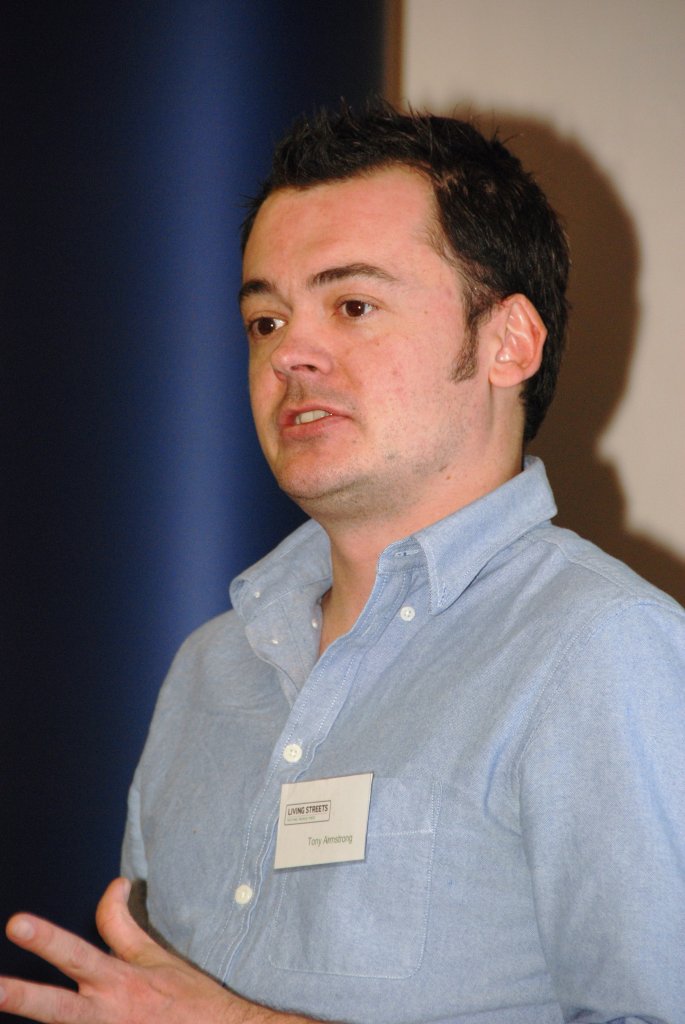
Tony Armstrong (Photo: Charlotte Gilhooly)

Tony Armstrong (Photo: Charlotte Gilhooly)

Tony Armstrong, Chief Executive Living Streets – new strategy and plans for years ahead

Tony began by saying that Living Streets existed to make walking safe and attractive, and then went on to give some reminders of what could detract from these ideals, including: subways; complicated and bewildering junctions (poor desire lines, often prioritised against people on foot); railings (as many are not there for safety but were installed before parking restrictions); pavement parking; lack of capacity (narrow pavement width with capacity traditionally provided for the motorist); the breakdown of communities (as highlighted by Professor Donald Appleyard in Liveable Streets, San Francisco (1981), and in a study by Joshua Hart, Bristol (2008)); and the obsession with street signs that can give too much information to the motorist.

Tony was generally supportive of the current policy climate including Manual for Streets, and sustainable transport initiatives. Read the rest of this entry »

Michael Loveday

Mike Loveday (Photo: Charlotte Gilhooly)

Mike Loveday, chair of Living Streets – putting Living Streets 80th year in context

Mike gave a history of the organisation, highlighting decade by decade advances. In 1928, when the Pedestrians Association was formed, there was no Highway Code, no driving test (a driving license could be purchased for 5 shillings), and no speed limits. There were around 100,000 vehicles on the road and 6,127 road deaths were recorded during the year. By 2008 the number of vehicles has risen to 21 million while the number of deaths had fallen to 2,947. Read the rest of this entry »

Proposals to give pedestrians time to safely cross the road at the Windsor Castle junction in Carshalton are rejected. Charlotte Gilhooly reports

Last year we ran a ‘Green Man’ campaign at the busy intersection of the A232 Carshalton Road/The Parade with the B271 Beynon Road and B278 Park Hill (known locally as the Windsor Castle junction) in Carshalton.

As a group we believe the crossings are extremely dangerous as there are no green men on any of the junctions’ arms. This is highlighted by the fact that there are two local schools nearby.

Together with the support of Cllr Colin Hall and the headmistress of St Philomena’s we successfully persuaded TfL to run a consultation process, which they did.

As a result of the consultation process 50% were in favour of the proposed improvements, whilst 45% were against.

Read the rest of this entry »

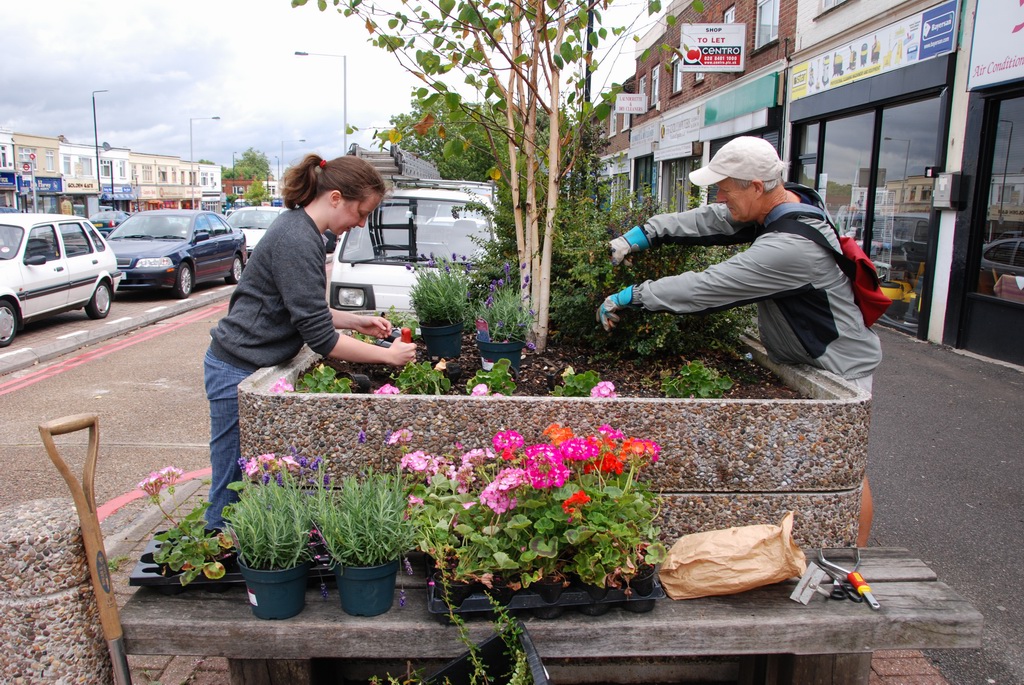
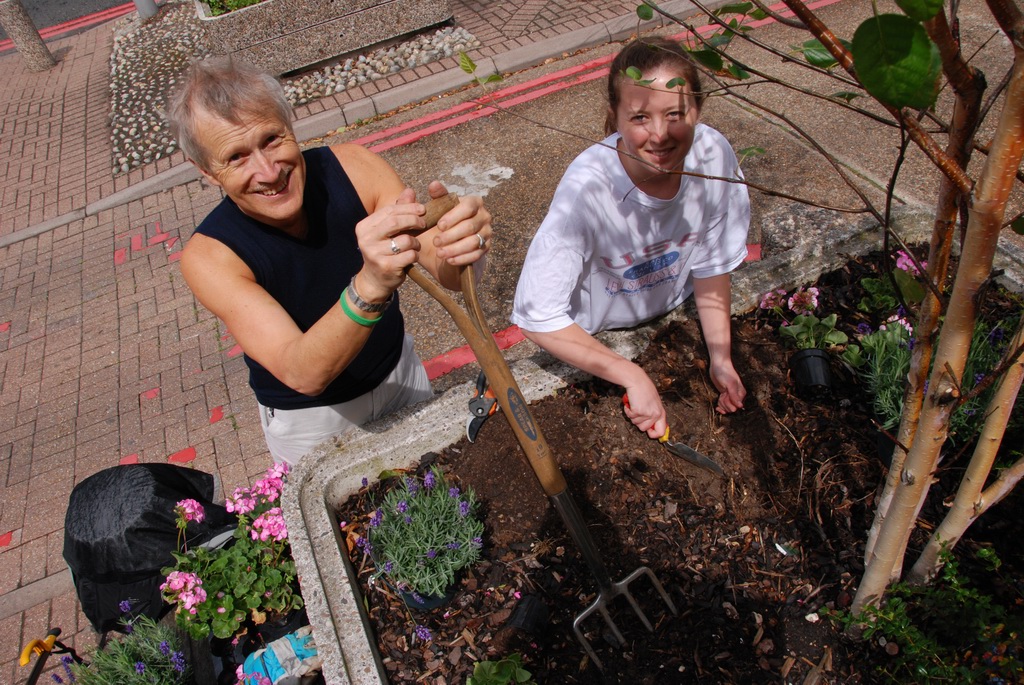
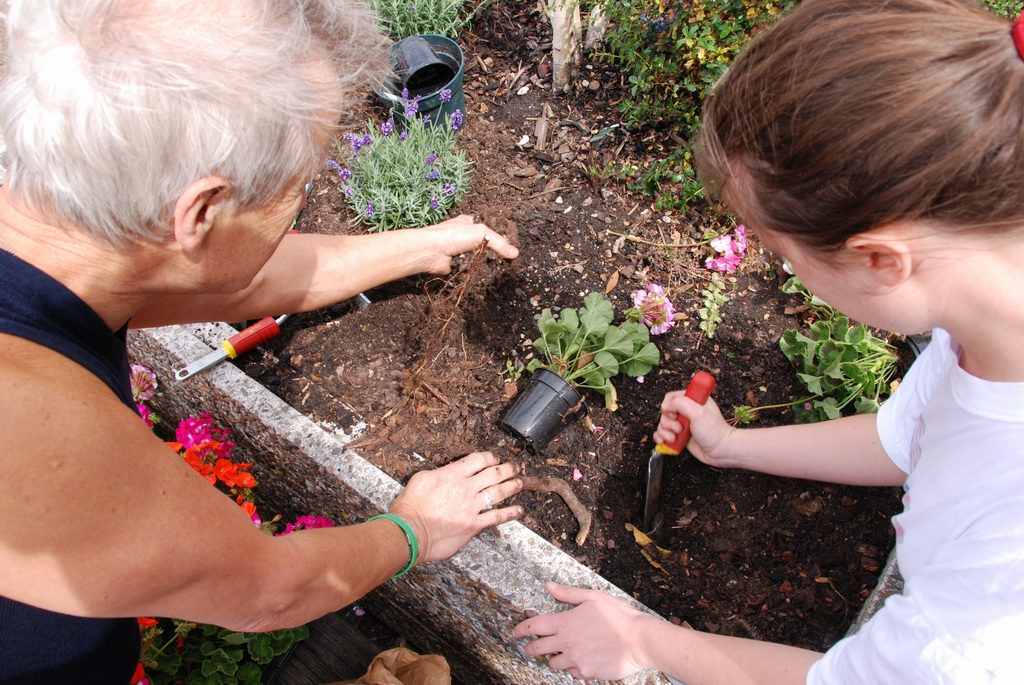
Stonecot in bloom Stonecot in bloom Stonecot in bloom

Stonecot Hill in Sutton can look forward to a brighter and more colourful summer after volunteers from Sutton Living Streets gave the street planters a seasonal makeover.

Bright purple lavender plants and pink geraniums now shine alongside the more muted trees and shrubs, which themselves have had a timely trim.

The planting is part of Sutton Council’s Take Part Take Pride week, which encourages residents to organise events in their neighbourhoods to bring people together socially and to improve the places where they live.

Campaigner and keen gardener Charlotte Gilhooly said,

The planters have been dull for a long time and we wanted to do something about it now that summer’s here. We were really pleased when we heard about Take Part Take Pride and asked if we could use the opportunity to brighten up our neighbourhood. We’re delighted with the results and looking forward to keeping the planters in shape.

Sutton Council has been awarded Beacon status for promoting greener, safer and cleaner public spaces. The citation reads:

Sutton has a strong vision for the local area. The ‘Take Pride, Take Part’ theme is effective and there is strong emphasis on the environment. The Phoenix Centre is an excellent example of bringing services into the heart of a deprived community. The youth service, particularly the radio station which provides young people with skills in broadcasting and sound engineering, was really impressive. The Bee Hive café, which is run as a social enterprise, was inspirational.

Council leader Sean Brennan said:

This award is a tribute to the park rangers, the street teams, the conservationists and to our partners in the police service and in Smarter Travel Sutton – they have all worked together to ensure Sutton residents can enjoy clean streets, award-winning parks, top-notch recycling services, green travel opportunities and low crime rates.